4Topix here we have discussions about anything you want to discuss
Money
(@J-Money)
(ID: 331)
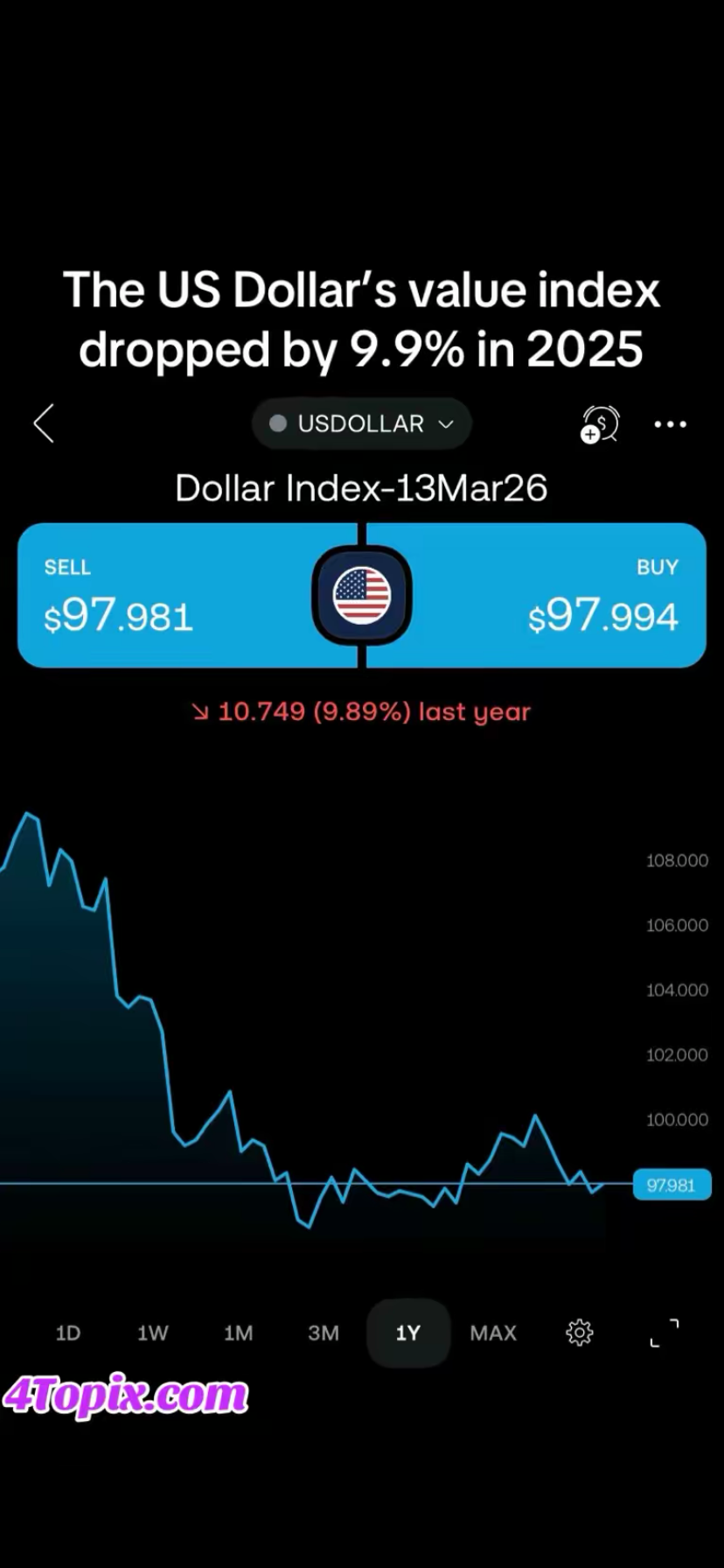
The Dollar index shows the average value of the US Dollar in comparison to six currencies: Euro, Japanese Yen, British Pound, Swedish Krona, Canadian Dollar and Swiss Franc. It dropped by 9.9% in 2025
I don't believe in Bitcoin because it has no use. If governments want a digital currency, they can get one made easily. In the short term you can make money from it but ultimately it is not worth much.
Billionaire wealth has more than doubled in the past 10 years, reaching 14 Trillion dollars
https://fortune.com/europe/2024/12/06/billionaires-wealth-doubled-14-trillion-ubs/MoneyBeing a NEET
The U.S. Dollar Index (USDX, DXY) measures the value of the US dollar against a basket of six major foreign currencies: the Euro (EUR), Japanese Yen (JPY), British Pound (GBP), Canadian Dollar (CAD), Swedish Krona (SEK), and Swiss Franc (CHF)
When it goes up thé it means thé Dollar is getting stronger, down means weaker.
This graph starts when Donald Trump took office for the second time. It shows the Dollar has been getting weaker since then. It has weakened by 11% at the time Im posting.
China's trade surplus has now reached 1 Trillion US Dollars for the first time. (Having a surplus means a country makes more money from exporting than importing; a deficit is the opposite, spending more money importing than money made exporting). This wasn't even a full year's trade but from January to the end of November 2025.
This comes after US President Trump imposed tariffs on products coming from China, this made it more expensive for Chinese sellers to sell goods to America. The sellers began trading more with other countries, the result has been increased surplus for China.
The US Federal Reserve has cut its key interest rate to a target range of 3.50% to 3.75%, a reduction of a quarter percentage point (25 basis points). This decision was announced on December 10, 2025, and marks the third rate cut of 2025.
The cut comes amid signs of a cooling labour market, including stalled job growth and higher unemployment, which prompted policymakers to provide an economic boost.
On 1-Jan-2026, the Euro became Bulgaria's national currency. It is now the 21st country using the Euro. The former currency (Bulgarian Lev) will also be accepted until 31-Jan-2026, after that, it will be out of use. People will still be able to convert the Lev to Euros until 30-June-2026.